

Employee onboarding is one of the most important processes in a small company, yet it is often managed without a clear structure. New employees may arrive without the equipment, system access, or guidance they need to get started. Meanwhile, managers and colleagues are busy with their existing responsibilities, leaving new starters to work things out on their own.
Poor onboarding can delay productivity, create unnecessary confusion, and increase the risk of early employee turnover.
An effective employee onboarding process does not require a dedicated HR department or an expensive onboarding platform. Small companies can create a structured experience with proper preparation, clearly assigned responsibilities, and consistent communication.
This guide explains how companies with fewer than 50 employees can develop a practical 90-day onboarding process that helps new employees understand their roles, contribute meaningfully, and become independent over time.
A structured employee onboarding process helps small companies prepare new hires, establish clear expectations, and create a productive working environment from the first day.
Employee Onboarding Process: Preparing Before Day One
The onboarding process should begin before an employee’s first working day. Preparing essential resources in advance prevents unnecessary delays and helps new employees feel welcomed from the beginning.
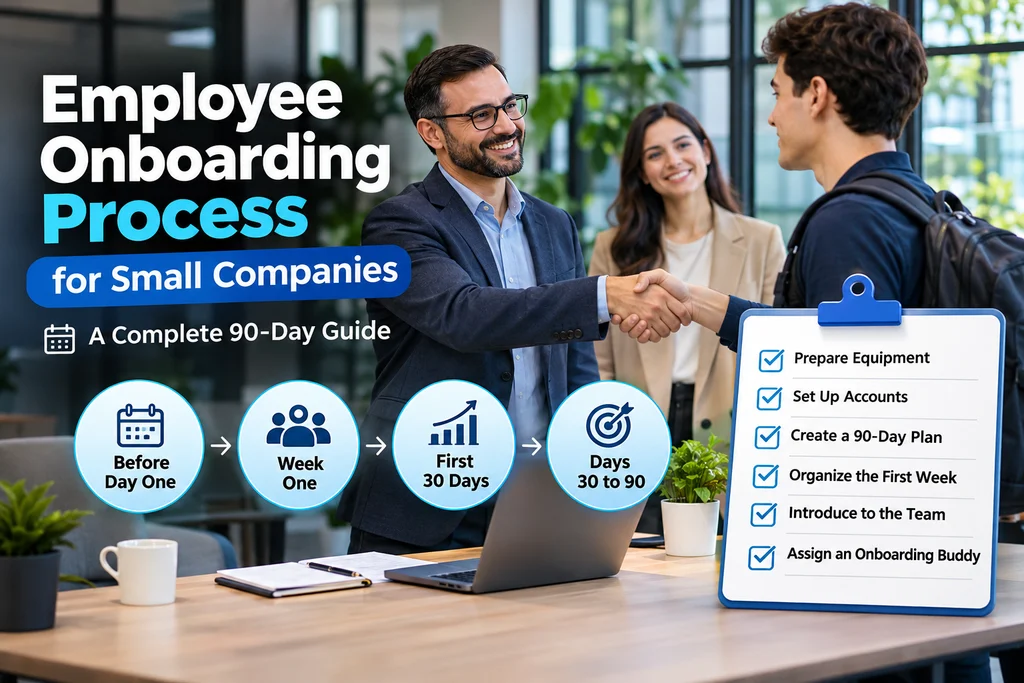
Use the following checklist to prepare for a new employee’s arrival:
- Prepare equipment: Order and configure the employee’s laptop, phone, and other necessary equipment before their start date.
- Create system accounts: Set up access to email, communication platforms, project management tools, and other required systems. Test all accounts before the employee arrives.
- Develop a 90-day onboarding plan: Document learning objectives, responsibilities, and milestones for the first 30, 60, and 90 days.
- Organize the first week’s schedule: Arrange introductory meetings, training sessions, and time for independent learning.
- Introduce the new employee to the team: Share their name, job title, responsibilities, and start date with relevant colleagues.
- Assign an onboarding buddy: Choose an experienced team member who can answer everyday questions and explain how the company operates.
A new employee who spends their first morning waiting for a laptop or requesting basic account access may form a negative impression of the company. Most of these problems are preventable with a little preparation.
A well-organized Employee Onboarding Process helps small businesses avoid these delays and ensures that new employees have everything they need before their first working day.
Week One: Building Belonging and Providing Context
The first week should help new employees understand the company, their responsibilities, and the people they will work with.
The objective is not to maximize productivity immediately. Instead, employees should receive enough context, guidance, and support to begin contributing confidently.
Day One: Introductions and Orientation
The first day should include:
- A welcome meeting with the manager.
- An explanation of the employee’s role and responsibilities.
- An introduction to company tools, systems, and communication channels.
- A discussion of the 90-day onboarding plan.
- Introductions to immediate team members.
- A small, manageable task that helps the employee become familiar with the workflow.
A practical first task might involve updating an internal document, reviewing an existing process, or responding to a simple customer inquiry under supervision.
The goal is to help the employee understand how work gets done without overwhelming them with information.
The Rest of the First Week: Learning How the Team Works
During the remaining days, arrange short introductory conversations with colleagues and relevant departments.
Where appropriate, new employees should also have opportunities to:
- Observe customer meetings or review customer interactions.
- Understand how projects move from planning to delivery.
- Learn which decisions have already been made and which are still under discussion.
- Review internal documentation and company procedures.
- Understand communication expectations and team responsibilities.
Avoid filling every available hour with meetings. Employees need time to explore their tools, review documentation, and ask questions as they become familiar with their new environment.
The First 30 Days: Delivering an Initial Contribution
By the end of the first month, employees should understand their primary responsibilities and be working toward an initial meaningful contribution.
One of the most effective ways to achieve this is through a carefully selected first project.
The project should be:
- Relevant: Connected to the employee’s actual responsibilities.
- Manageable: Small enough to complete within the first month.
- Low-risk: Appropriate for someone who is still learning company processes.
- Meaningful: Valuable to the team rather than simply an exercise designed to keep the employee busy.
Managers should provide appropriate guidance without taking ownership of every task.
For example, a new marketing employee might prepare a content brief, an engineer might resolve a small development issue, and a sales representative might assist with a qualified lead under supervision.
The objective is to create opportunities for practical learning while helping employees develop confidence and understand how their work contributes to company goals.
A clear Employee Onboarding Process helps new employees understand their responsibilities, follow clear goals, and contribute to the company during their first month.
Days 30 to 90: Developing Employee Independence
The second and third months should gradually move employees from guided learning toward greater independence.
Responsibilities should increase as employees demonstrate their understanding of the role, company processes, and expected standards.
By Day 30: Understanding the Role
Employees should:
- Understand their primary responsibilities.
- Have completed an initial meaningful task or project.
- Know where to find essential information.
- Understand how to communicate with colleagues and managers.
- Be familiar with the company’s main tools and workflows.
By Day 60: Taking on More Responsibility
Employees should be progressing toward:
- Handling routine responsibilities with less supervision.
- Participating in team discussions and planning.
- Managing regular tasks with increasing confidence.
- Identifying problems and finding appropriate solutions.
- Understanding how their work contributes to wider business objectives.
By Day 90: Working Independently
Employees should be able to:
- Manage the core responsibilities of their position with an appropriate level of independence.
- Complete routine work according to company standards.
- Communicate effectively with relevant colleagues and stakeholders.
- Identify opportunities to improve existing processes.
- Understand their next development priorities.
Managers should arrange structured check-ins at each milestone. These conversations should review progress against the original plan, identify challenges, and determine whether additional training or support is necessary.
The 90-day plan should remain flexible. Expectations may need to change depending on the complexity of the role and the employee’s previous experience.
Regularly reviewing the Employee Onboarding Process allows managers to identify gaps, improve training, and ensure that employees receive the support they need.
Employee Onboarding Documentation: Building an Internal Knowledge Base
Documentation is essential for making employee onboarding consistent, especially in smaller companies where important information often exists only in employees’ experience and informal conversations.
Without written processes, every new employee may depend on the same colleagues for repeated explanations.
Start by documenting the information employees need most frequently:
- Tools and technical setup: Instructions for accessing company systems, setting up development environments, and configuring essential software.
- Workflows: How projects move from initial planning to completion.
- Roles and responsibilities: Who owns specific tasks, decisions, and business functions.
- Decision-making processes: Where important decisions are recorded and how employees can find them.
- Internal terminology: Definitions of company-specific terms, abbreviations, and commonly used expressions.
- Communication guidelines: Which channels to use for questions, project updates, and urgent issues.
Keep documentation organized, accessible, and regularly updated.
An additional practice is to ask new employees to identify confusing or missing information during their first month. Their feedback can reveal gaps that existing team members may no longer notice because they are already familiar with company processes.
Maintaining clear documentation is an important part of the Employee Onboarding Process because it helps every new employee follow consistent procedures.
For additional guidance on human resources management and workplace practices, visit the official Society for Human Resource Management (SHRM) website.
The Manager’s Role in Employee Onboarding
Employee onboarding is not simply an administrative responsibility. The hiring manager plays a central role in helping new employees understand expectations, develop confidence, and become productive.
Three management practices deserve particular attention.
A consistent Employee Onboarding Process also helps managers track progress, provide timely feedback, and support long-term employee development.
1. Schedule Regular One-to-One Meetings
Arrange weekly one-to-one meetings from the first week.
These conversations provide an opportunity to discuss progress, answer questions, review workload, and identify difficulties before they become larger problems.
2. Provide Early and Constructive Feedback
New employees should receive clear feedback while they are still learning.
Small misunderstandings can often be corrected quickly when addressed early. Managers should explain what is working, what needs improvement, and how employees can make progress.
3. Make Support Accessible
Managers should communicate when and how employees can ask for help.
A new employee who feels uncomfortable interrupting colleagues may avoid asking important questions. Regular check-ins and an approachable management style help create an environment where questions are welcomed.
Remote Employee Onboarding: Best Practices for Small Companies
Remote onboarding requires more deliberate planning because new employees cannot rely on everyday office interactions to understand company culture, processes, and expectations.
The same onboarding principles apply, but communication and documentation become even more important.
Companies should:
- Provide written onboarding documentation before the employee’s start date.
- Test equipment, software, and account access in advance.
- Schedule introductory video meetings with relevant team members.
- Assign an onboarding buddy who can provide regular support.
- Arrange additional manager check-ins during the first two weeks.
- Clearly document communication channels, working hours, and response expectations.
- Provide opportunities to observe customer meetings and team discussions remotely.
When possible, choose an onboarding buddy whose working hours overlap with the new employee’s schedule.
Remote managers should also avoid assuming that silence means everything is going well. Regular communication helps identify confusion and isolation before they affect performance.
For more guidance, see our article on Remote Team Management Best Practices.