

Introduction
A successful retargeting strategy helps businesses reconnect with people who have previously visited their website but did not complete a desired action. These visitors may have explored a product, checked pricing, read an article, or started a signup process. Retargeting gives businesses another opportunity to reach them with relevant advertisements.
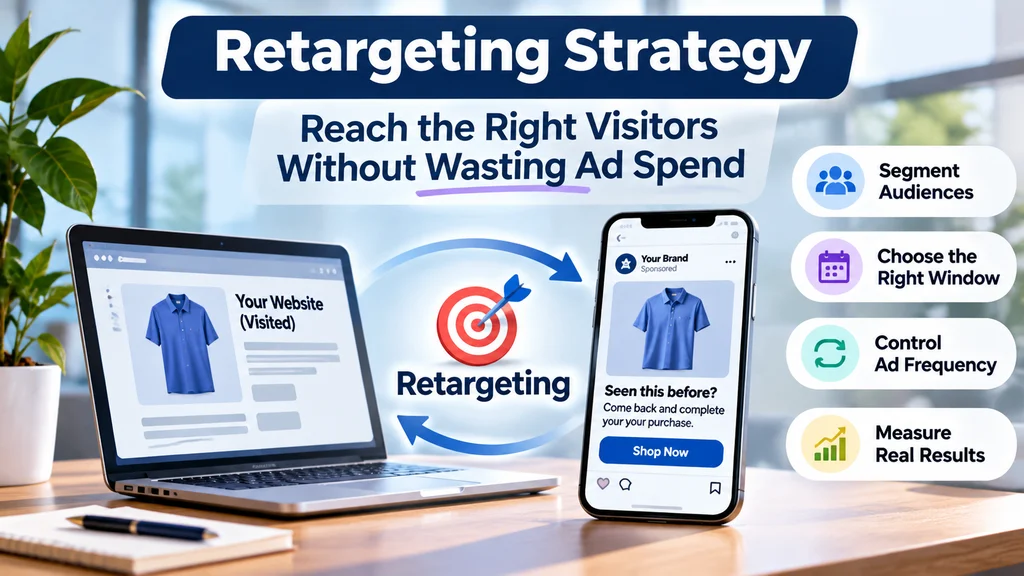
However, retargeting is not automatically profitable. Advertising platforms can report impressive conversion figures while taking credit for customers who might have returned without seeing another advertisement. To get better results, businesses need to focus on audience quality, relevant messaging, controlled ad frequency, and accurate performance measurement.
1. Build a Retargeting Strategy Around Audience Intent
Not every website visitor has the same level of interest. Treating all visitors as one audience can waste advertising budget. Instead, divide visitors according to their actions.
- General website visitors: People who viewed a homepage or blog post. Show them educational content, useful resources, or relevant articles rather than an immediate sales pitch.
- Product and pricing visitors: These visitors may be comparing solutions. Use product benefits, customer testimonials, pricing information, and answers to common objections.
- Abandoned signups or forms: People who started a trial or application but did not finish may have stronger buying intent. Send a relevant reminder and address possible reasons for abandoning the process.
- Existing customers: Exclude them from new-customer acquisition campaigns. Create separate campaigns for upgrades, renewals, or complementary products.
Prioritize audiences according to their demonstrated intent, not simply their size.
2. Choose the Right Retargeting Window
The retargeting window determines how long someone remains eligible to see your advertisements after visiting your website. The right duration depends on the product and customer decision-making process.
For low-consideration purchases, a 7–14-day window may be a useful starting point. For B2B software with longer evaluation periods, 30–90 days may be more appropriate.
Use shorter windows for general visitors and consider longer windows for high-intent prospects. Review performance regularly because older audiences may become less relevant over time.
3. Control Ad Frequency and Creative Fatigue
Showing the same advertisement repeatedly can frustrate potential customers and reduce campaign performance. This problem is known as ad fatigue.
Where the advertising platform supports frequency controls, start with a modest exposure limit and adjust it according to audience response. Monitor frequency alongside click-through rates and conversions.
If frequency increases while engagement declines, refresh the creative, test different messages, or reduce exposure. Rotate advertisements regularly and use different visuals, offers, and calls to action to keep campaigns relevant.
4. Exclude Irrelevant Audiences
Audience exclusions are just as important as targeting. Consider excluding:
- People who have already completed the desired conversion.
- Existing customers from new-customer acquisition campaigns.
- Visitors with very short or irrelevant sessions, where reliable engagement data is available.
- Employees and internal website traffic.
These exclusions help reduce wasted impressions and prevent businesses from advertising irrelevant offers to the wrong people.
5. Measure Incremental Results
Retargeting platforms often report strong returns because their audiences already know the business. However, attributed conversions do not necessarily represent additional sales generated by advertising.
A holdout test provides a more reliable way to measure incremental impact. Divide an eligible audience into two comparable groups. Show retargeting advertisements to one group while withholding them from the other. Compare their conversion rates over a period that reflects the typical sales cycle.
The difference helps estimate how many additional conversions the campaign actually generated. Businesses should also report retargeting separately from prospecting campaigns to avoid overstating overall advertising performance.
To understand how conversion credit is assigned across marketing channels, read our guide to marketing attribution models.
6. Select the Right Channels and Creative
Different channels serve different purposes, so businesses should choose them according to audience behavior.
- Search advertising: Can reach previous visitors when they return to search for relevant solutions, where audience targeting options are available.
- Display advertising: Helps maintain brand visibility during longer buying cycles.
- Social advertising: Supports customer testimonials, product demonstrations, and visual campaigns.
- Email follow-ups: Can re-engage people who voluntarily provided their contact details, subject to applicable consent and email marketing requirements.
Avoid repeating the same homepage advertisement. Instead, use customer results, clear product benefits, answers to common objections, and simple next steps.
7. Respect Privacy and Consent
Cookie restrictions, tracking prevention, and privacy regulations affect retargeting audience size and measurement accuracy.
Businesses should use consent-based tracking where required, follow applicable privacy laws, and rely on first-party data collected and used appropriately. They should also review advertising platform policies before creating audience lists.
Do not assume that every website visitor can legally or technically be added to an advertising audience. Transparent data practices help protect customer trust and reduce compliance risks.
For guidance on responsible data collection and online tracking, businesses should review the Google Ads personalized advertising policies.
Final Thoughts
An effective retargeting strategy is not about showing more advertisements to more visitors. It is about identifying meaningful intent and delivering relevant messages at the right time.
A well-planned retargeting strategy also requires regular audience reviews, relevant advertising messages, and reliable conversion tracking to ensure that campaigns deliver measurable results.
Start with two audience segments: high-intent visitors and general website visitors. Exclude people who have already converted, monitor ad frequency, test different creatives, and measure incremental conversions. Expand your retargeting strategy only when performance data shows that additional advertising spend is generating genuine business value.